The Project
Molten Light is a public, ground-up build of a 1-metre class robotic telescope, starting with the glass and ending with an autonomous observatory. The core technical bet is that a spin-casting process for borosilicate honeycomb mirrors can bring large-aperture optics at this scale, 1m and eventually 1.5m, down to a cost and complexity a small team can carry, working deliberately and in public.
The short version is engineering a telescope from first principles. The longer version is that every subsystem, from the furnace that casts the blank to the software that parks the scope at dawn, is being designed, analysed, and documented with the same discipline as a small space programme.
The origin
I built my first telescope at sixteen. A 16-inch F/4.5 Dobsonian, AltAz mount and electronics from scratch, stepper-motor drives wired to a control board built to Mel Bartel's specifications, running over RS-232 to a laptop on scope.exe under MS-DOS. It worked. It also didn't. The frame flexed in ways I could not predict nor correct, because I did not yet have the tools. That gap, between knowing something was wrong and having the means to fix it properly, stayed with me.
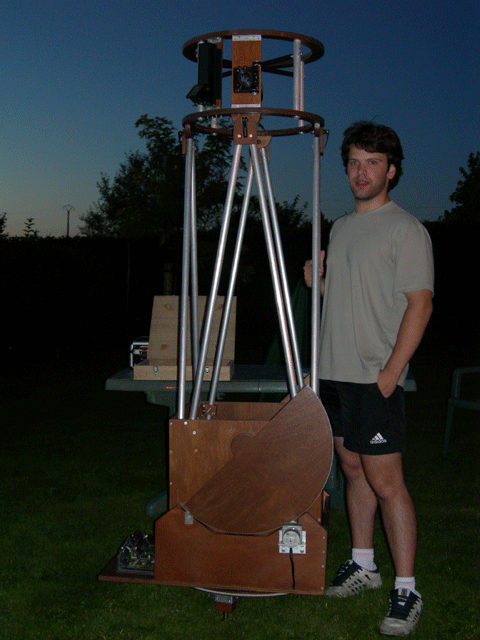
Twenty years later, I have the tools. Back then I could already find amateur literature on building 1-metre class scopes mechanically and structurally. The optics at that aperture were the gap, and mostly still are. Of the people who have tried to melt their own mirror blanks, the largest I have seen is around 600mm, ground and figured conventionally, without the materials and thermal engineering the glass process actually calls for. That is the part I want to work through, carefully and in public.
The approach
The central technical programme is spin casting a borosilicate honeycomb mirror blank in a purpose-built rotating furnace. The honeycomb gives the stiffness-to-mass ratio the aperture requires without the weight of a thick solid disc. Spin casting produces the parabolic figure directly from the melt, which removes most of the material that would otherwise have to be ground away during optical figuring. Borosilicate makes all of this feasible at workshop scale in a way fused silica does not, without infrastructure I am not going to have access to.
From the blank, the programme continues through interferometric figuring, vacuum aluminium coating, a structurally and thermally analysed Optical Tube Assembly and mirror cell, a mechatronic mount built to track accurately without flexure (one of the problem I could not solve at sixteen), and autonomous observatory software for unattended nightly operation.
Every phase produces a research log, full technical depth with no simplification, and eventually video documentation of the build itself.
Where things stand
Early. The design work is underway and the first research logs are being written. No glass has been cast. The furnace is in design, not fabrication. I am publishing the thinking as it happens rather than waiting until the hardware exists, because the thinking is most of the actual engineering, and it is the part that benefits most from being held up to public scrutiny while it can still be corrected.
Readers who know more than I do about any phase of this, whether glass science, optical metrology, control systems, or anything else, are a large part of who I am writing for. So is anyone who just wants to follow the build for its own sake.
The engineering background
I'm Hugues Henrion, an aerospace engineer based in Belgium. My training covers mechanical engineering and applied physics and chemistry, which between them reach into materials science, statistical physics and phase transitions, (in)organic chemistry, and the physics of semiconductors and electronics. Professionally, I have spent most of my time on structural and thermal analysis of flight-critical hardware for the European space and defence industry, after an earlier stint on an electromechanical deployment mechanism for a solar sail.
More recently I spent a year inside the ESA Business Incubation Centre Wallonia programme, where part of my work brought me into regular contact with the Centre Spatial de Liège, one of the main optical testing and coating facilities used by ESA science missions. It is a place I have a lot of respect for, and getting to know the people and the work there during that period has informed how I think about the optical side of this project.
My professional engineering writing, on systems engineering methodology, MBSE in Capella, structural analysis, and ECSS standards, lives at secondstage.space. The two sites are two halves of the same practice. Second Stage is where I work through the methodology. Molten Light is where it gets applied to the one project I have been aiming at the longest.
Deep engineering. Open sky.